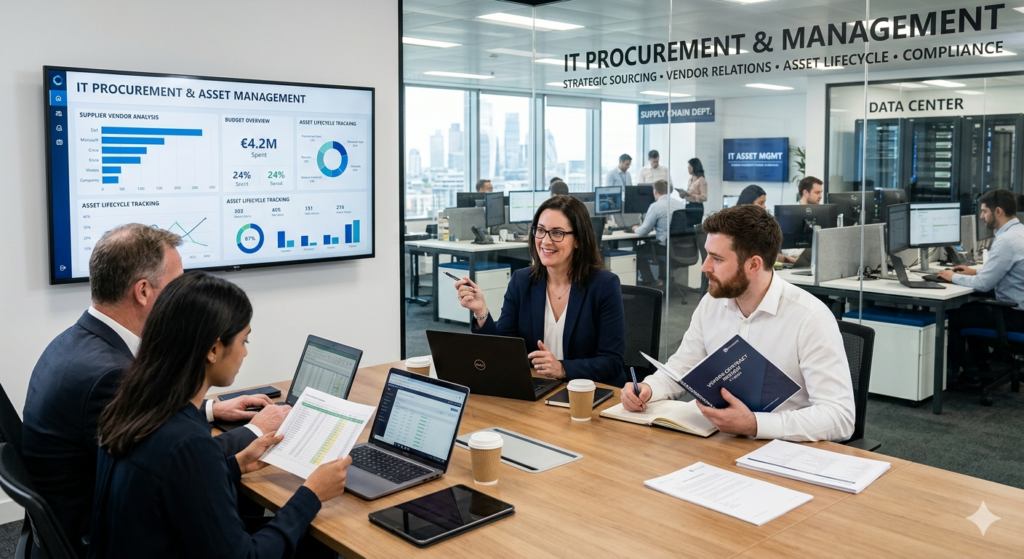
As an IT procurement manager or director, you need to eliminate waste, mitigate vendor risk, and accelerate deployment timelines. Our structured framework transforms your IT asset management and procurement from a reactive cost center into a strategic operational advantage.
1. Requirements Setting
- Stakeholder Alignment: We run collaborative workshops to document technical specifications and operational dependencies across departments.
- Shadow IT Elimination: We audit your current infrastructure first to prevent fragmented software spending and duplicate tool duplication.
- Business Case Creation: Every requirement is tied to a definitive business case to ensure direct alignment with corporate goals.
2. Acquisition
- Structured RFP Management: We build and distribute comprehensive Requests for Proposals to ensure competitive, standardized bidding.
- Data-Driven Scoring: Vendor bids are objectively scored against functional criteria, budget constraints, and delivery timelines.
- Strategic Sourcing: Market research data is leveraged to secure fair market value and maximize upfront purchasing leverage.
3. Contract Execution
- SLA Optimization: We negotiate aggressive Service Level Agreements to secure robust uptime guarantees and clear financial penalties for vendor misses.
- Centralized Repository: Signed agreements are digitized in a single platform with automated alerts for expiration and auto-renewal dates.
- Risk Mitigation: Contract terms are legally insulated against hidden software licensing traps and sudden price escalations.
4. Vendor Management
- Risk Dashboards: Automated scorecards continuously track supplier compliance, financial stability, and operational performance.
- Vendor Consolidation: Overlapping suppliers are consolidated under a smaller network to reduce administrative overhead and unlock volume discounts.
- Performance Reviews: Regularly scheduled reviews hold vendors accountable and resolve systemic bottlenecks before they impact operations.
5. Asset Management
- Lifecycle Tracking: Hardware, software, and cloud assets are logged in a central registry tracking ownership, cost, and depreciation.
- License Optimization: Real-time usage analytics identify underutilized SaaS licenses so you can harvest and reallocate them.
- Audit Defense: Continuous compliance monitoring ensures your organization is perpetually prepared for aggressive external publisher audits.
6. Quality Management
- Procurement KPI Tracking: We measure and optimize core metrics, including procurement cycle times, budget variances, and cost-savings ratios.
- Feedback Loops: Post-deployment reviews with end-users identify deployment bottlenecks to continuously refine the onboarding workflow.
- Scalability Audits: System architectures are regularly verified to guarantee your IT assets scale smoothly alongside business growth.
IT Procurement & Asset Management Best Practices
Implementing these tactical guidelines helps procurement managers and directors minimize waste, maintain compliance, and increase operational efficiency.
Requirements & Acquisition
- Establish a Cross-Functional Review Board: Include IT, security, finance, and legal teams early to evaluate all high-value tech purchases.
- Enforce a “Three-Bid” Minimum Rule: Require at least three competitive vendor proposals for any purchase exceeding a set financial threshold.
- Standardize Hardware Profiles: Limit employee device choices to a small set of pre-approved configurations to simplify bulk purchasing and support.
Contract & Vendor Management
- Negotiate Growth-Capped Pricing: Lock in predictable renewal rates upfront to prevent sudden vendor price hikes at the end of a contract term.
- Tie Payments to Milestones: Structure implementation contracts so that final vendor payouts are contingent upon passing clear user acceptance testing.
- Schedule Semi-Annual Vendor Reviews: Meet regularly with tier-one suppliers to evaluate performance scorecards and address service slips.
Asset & Quality Management
- Automate License Reclamation: Configure system alerts to automatically flag and revoke software licenses from users who have been inactive for over 30 days.
- Maintain an Audit-Ready Buffer: Keep an updated buffer of spare software licenses and hardware inventory to support rapid employee onboarding.
- Formulate a Rigid Offboarding Checklist: Implement strict asset recovery protocols that instantly revoke digital access and reclaim physical hardware on an employee’s final day.
Frequently Asked Questions (FAQ)
Q: How does this framework accelerate our average IT procurement cycle times?
A: By standardizing the Requirements Setting and Acquisition phases, we eliminate prolonged departmental back-and-forth. Pre-built RFP templates and objective vendor scoring models allow your team to move from initial need identification to contract signing up to 40% faster.
Q: Can this framework help us identify and eliminate duplicate SaaS subscriptions?
A: Yes. The Asset Management module tracks software usage analytics across all departments in real time. This visibility allows procurement directors to immediately spot redundant tools, harvest underutilized licenses, and consolidate vendors to maximize volume discounts.
Q: How do you protect our organization against aggressive vendor software audits?
A: We maintain an audit-ready Centralized Asset Registry that pairs active software license counts directly with active hardware allocations and user profiles. This continuous compliance tracking ensures your actual usage never exceeds your contractual entitlements, eliminating unexpected true-up penalties.
Q: What metrics do you use to evaluate vendor performance over time?
A: Our Vendor Management system utilizes automated scorecards to track key performance indicators (KPIs). These include SLA uptime compliance, delivery lead times, billing accuracy, and customer support responsiveness, giving you concrete data for renewal negotiations.
Q: How does this framework handle the secure offboarding and disposal of physical hardware?
A: The Asset Management phase includes structured end-of-life protocols. We manage the entire asset retirement workflow, which mandates documented data sanitization, physical destruction tracking, and the issuance of legal Secure Data Destruction Certificates for your compliance records.
